Chapter 10
2027 Preview
In May 2027, in a kitchen in suburban Denver, a forty-six-year-old will be making coffee. She will be looking out the window at the neighbor’s truck — the same truck she has been seeing for ten years, parked in the same driveway, belonging to the same plumber she has waved at for a decade. Three things will be different about that morning compared to the same morning in May 2025. The neighbor’s truck will be one of four trucks his company now owns. Her own former employer’s headquarters, three exits down the highway, will be 28% smaller than it was the day she left. And she will be, herself, running a Solo Operator practice that cleared $340,000 in the first twelve months and is on track to clear $600,000 in the second.
She will be having coffee with a copy of The Operator: 2027 on the kitchen counter, opened to the introduction. The seats are taken in the year after the book. She remembers the line from the 2026 edition. She is glad she got there first.
The fourth thing about that morning is the one she will not see. Three states away, Chris — fourteen months out of work, runway long gone, now eleven months into a contract role at 60% of his old salary, still telling himself it is temporary — will be opening his laptop at 6:15 a.m. He will open his inbox first. He read the same book she did. They both finished it on a Sunday. She started Monday. He decided to start soon.
This is the last chapter of The Operator: 2026.
By the time you read it, you have done one of two things. Either you have run the chapters in this book honestly — the audit, the equation, the safeguard, the pivot, the daily practice, the boss meeting — and you are, six months from now, going to look back at this paragraph and recognize that the next twelve months of your life began here.
Or you have read the chapters without running them. In which case the rest of this chapter is not for you. The equation will still be true twelve months from now. The labor market will have continued to move in the direction this book described. The chapters will still be here when you decide to run them.
For the readers who have run the chapters: this is the chapter where you find out what is coming next — and what the long arc, the move from Class 3 Operator to Class 4 Owner, actually looks like over the next five to seven years.
This is also the chapter where I tell you, plainly, what I am betting on as a working operator and a working founder.
The Trajectory in One Chart
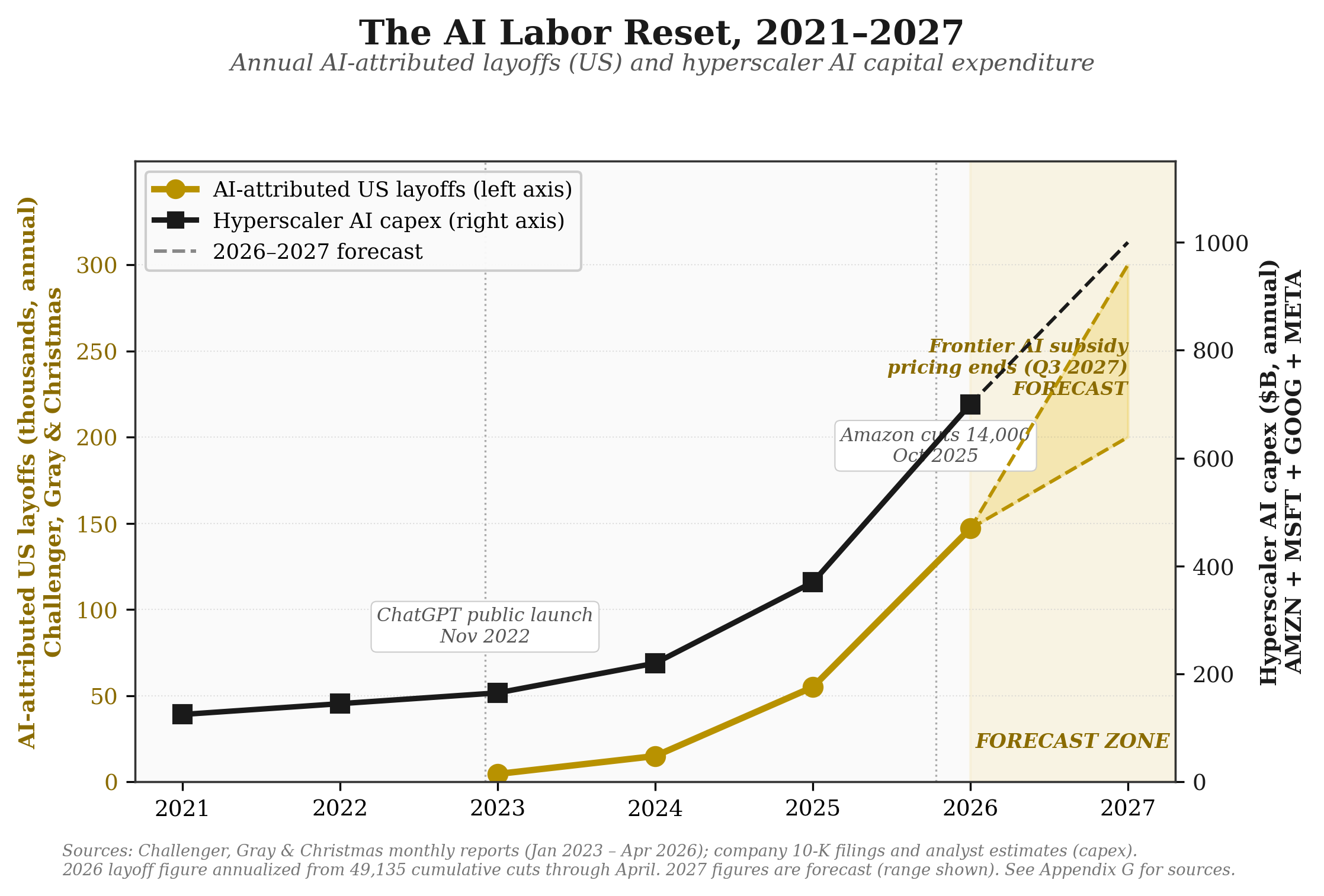
Two trajectories sit on top of each other and tell the same story. The gold line is annual AI-attributed layoffs in the United States, as logged by Challenger, Gray & Christmas every month since 2023. The black line is annual AI capital expenditure at the four hyperscalers (Amazon, Microsoft, Alphabet, Meta) — the money those companies are spending to build the infrastructure the AI runs on. They are not unrelated lines. The capex is the cause; the layoffs are the downstream consequence. Where the capex line goes, the layoffs line follows on a 12-to-18-month lag.
The 2026 figure is the one that matters most. Through April 2026, Challenger had logged 49,135 AI-attributed layoffs — almost the entire 2025 annual total reached in four months. AI is now the #1 cited reason for layoffs two months running, surpassing cost-cutting and restructuring. That trajectory, annualized, lands the 2026 total in the 140,000-to-160,000 range — roughly triple the 2025 figure.
The forecast band on the right side of the chart is the Prediction Register’s territory. The five predictions logged at the back of this book against the Q4 2027 due date are graded against that band. The book will be judged on whether the actual 2027 trajectory falls inside it, above it, or below it.
A note on the number. Not every AI-attributed layoff is pure substitution. Some of the cuts that get filed under “AI” are routine cost reductions wearing AI’s name — what Wharton’s Peter Cappelli has called “hopeful” attribution and what Sam Altman himself has acknowledged as “some AI washing where people are blaming AI for layoffs they would otherwise do.” Oxford Economics concluded in January 2026 that aggregate employment data does not yet show AI replacing workers at scale. All three of those caveats are real. What is also real: the money that paid for those roles is going into AI infrastructure instead. Andy Challenger’s framing, exact words: “Regardless of whether individual jobs are being replaced by AI, the money for those roles is.” That is what the right side of this chart shows. The mechanism is partly substitution and partly reallocation. The downstream consequence for the worker holding the laid-off seat is the same.
What is Going to Happen in 2027
Prediction One: Frontier AI pricing rises 5-15x. By Q3 2027 the AI-lab subsidies end. A $20/month tool becomes $100/month. A $200/month tool becomes $1,500/month. The Operator who built her stack on 2026 pricing absorbs it. The peer laborer falls off the tools entirely.
Prediction Two: White-collar Fortune 500 headcount drops another 18-30%. Q1 2026 set the modern record. Q1 2027 exceeds it. The 2026 cuts produced productivity gains, which gives every other CFO political cover. Cuts move from marketing / content / CS in 2026 to PM / mid-level engineering / mid-level legal / mid-level finance / senior ICs without AI fluency in 2027.
Prediction Three: The Operator’s market premium grows sharply. Senior Operators price in 2027 at $250-500/hr fractional and $300K-600K base FT. The Operator fluent and visible by Q1 2027 captures this premium for at least 3-5 years.
Prediction Four: 15-25% of laid-off white-collar workers pivot into AI-Proof Trades. Plumbing / nursing / electrical / HVAC programs report doubled application volume from 30-50yo career switchers. The trades absorb them; the metro labor shortage gets worse, not better. Trade-Plus-Stack owners (Chapter 5) see another year of margin expansion.
Prediction Five: The first wave of true Solo Operators clears $1M. A visible cohort positioned 2025-2026 hits $1M/year personal income with zero employees, 1-4 AI agents, and 4-10 retainer clients. The “$1M/year solo founder” archetype, a 2024 curiosity, becomes a known career category by end of 2027.
The Wager
A prediction with nothing behind it is content. So here is what is behind these five.
Each of the five predictions above is logged, dated, and graded in public — and the grading has a forfeit. In Q4 2027, I will score all five against the named sources (Challenger for the layoff data, public pricing pages for the tooling costs, the public revenue disclosures for the solo cohort). Each prediction gets one of three grades: HIT, PARTIAL, or MISS — posted, with the receipts, at theoperatorannual.com/register.
The forfeit: if two or more of the five predictions grade as MISS, the 2028 edition of this book is free — full text, day one — to every reader who logged a Diagnostic score in 2026. Not discounted. Free. You will not have to ask. The grading post will contain the link.
I want you to understand why I am doing this, because it is not generosity. The entire argument of this book rests on a forecast about the next eighteen months. You are being asked to move your one life on that forecast. It would be obscene for me to carry none of the risk. Authors in this category have spent decades being wrong for free. The least an annual edition can do — a book that grades itself every January by design — is post its own bond.
If I am right, you paid for a book that was right when it mattered, and the 2028 edition will cost you whatever it costs. If I am wrong, you will hear it from me first, in writing, with the data, and the next year of the work will be on the house.
I told you in the interruption chapter that I sell a few books a year. So the cynic will note, correctly, that this bond is small. It is. It is also every dollar this book makes. A bigger author would be risking a rounding error. I am risking the whole line. Size the wager by that.
Either way, you now know something about every sentence in this book that you did not know a page ago: I would not have written it this way if I were allowed to be wrong quietly.
The Five-to-Seven-Year Arc to Class 4
This book has been mostly about Class 3 — the Operator class — and its hybrid with Class 2. Most readers reading this book in 2026 will, if they execute well, be solidly in Class 3 by December 2026. That is the immediate game.
The longer game is Class 4 — Owner. The class above Operator. The class where the income-producing thing exists whether the Operator shows up or not.
I am not going to lie to you about how easy the Class 4 transition is. It is not easy. It takes 3-7 years from a standing Class 3 start. It requires a different operating posture than the Class 3 work. It requires capital, patience, and a tolerance for invisible compounding work that does not pay in the short term.
It is also, by every measure, the most important career-life transition available to a working knowledge worker who wants real freedom over the next two decades.
Here is the rough shape of the Class 3 → Class 4 transition, as I have seen it run across approximately a dozen operators over the last eighteen months:
Year 1 (Now): Establish Class 3. You are reading this book in 2026 because you are building the Class 3 position. The Solo Operator income. The Trade-Plus-Stack revenue. The vertical product or the audience build. By the end of 2026, you have measurable Class 3 income — call it $200K-500K personally. This is the foundation.
Year 2: Capitalize the Operator income. With the Class 3 income flowing, the most important move in Year 2 is direct a large portion of the income into building Class 4 assets. Not luxury consumption. Not lifestyle inflation. Assets. The Class 3 → Class 4 reader saves 30-50% of her Class 3 income and deploys it deliberately into the next stage. This is the year of resisting the lifestyle creep that destroys most ascending operators.
Year 3: Build the first Class 4 asset. You take the saved capital and the operating sophistication you have built and you build one specific Class 4 asset. Possible Class 4 assets for a Class 3 Operator:
- A real estate portfolio (typically 2-5 cash-flowing properties in your metro).
- An AI-agent business that runs on its own with light supervision.
- A real product business (Vertical Wrapper from Chapter 7) that has crossed product-market fit.
- A media property (newsletter, podcast, YouTube) at meaningful scale (50K+ subscribers, real ad and sponsorship revenue).
- An equity-stake-plus-operating-partner arrangement in a Class 2+3 Combined Stack business.
- A licensed/franchised version of an operating playbook you developed in Class 3.
Each of these is a real path. None of them is easy. All of them have been done in 2024-2025 by Class 3 operators who are now visibly Class 4 by 2026.
Years 4-5: Compound the first asset. The first asset throws off cash. You reinvest. The asset doubles or triples in scale. By year 5, the first asset is generating $200K-800K of passive or semi-passive annual income on top of your Class 3 income.
Years 6-7: The transition. Reduce Class 3 hours. Add a second Class 4 asset. With one asset compounding, you cut your Class 3 working hours from 35 to 20. You use the reclaimed time to build asset two. By year 7, you are technically in Class 4 — your asset income exceeds your labor income — and you are doing Class 3 work because you choose to, not because you have to.
This is the real arc. Seven years from a Class 3 start in May 2026 lands you in Class 4 by May 2033. That is the long bet.
The annual series goes deeper on each year of the arc — capitalization, first-asset construction, compounding, transition — one edition at a time. You started here.
The Three Most Common Class 3 → Class 4 Collapse Modes
Most Class 3 Operators who attempt the Class 4 transition fail at one of three specific automation choices. The collapse is not about effort. It is about which function you automated and what you did with the time you reclaimed.
| Automation focus | Result | Why it fails |
|---|---|---|
| Client delivery (your core service) | Income scales. You are still trading hours, just faster ones. | You built a busier Class 3, not a Class 4 asset. The work remains tied to your name and your calendar. |
| Back-office (quoting, scheduling, follow-up, intake) | You reclaim ~20 hrs/week. | This is the right move — but only if you redeploy the reclaimed hours into an asset, not into more client work. Most Operators redeploy into more client work and stay Class 3 forever. |
| A product you do not understand | You burn 9 months building something nobody buys. | The most common Class 3 → Class 4 collapse. The Operators who succeed build for the customer they already know intimately. The ones who fail chase a market they read about on Twitter. |
The Class 3 → Class 4 reader who survives this transition is the one who automates the back office, redeploys the reclaimed hours into an asset they understand the buyer for, and accepts that the asset will compound on a 24-36 month timeline, not a 90-day one.
What I Am Personally Betting On
Operator to Operator, founder to founder, peer to peer — here is the bet I am personally making with my own working hours and my own capital.
I am betting that the next decade will be the most concentrated period of personal wealth and capability creation in modern history, for the small fraction of people who position correctly in 2026 and execute through 2030. I am betting that the solo-or-near-solo operator with AI agents will be the dominant successful business form by 2030. I am betting that the Combined Stack — Class 2 trade plus Class 3 operating layer — is the most defensible position on the modern economic chessboard for the next 20 years. I am betting that the cultural script you came up in is fundamentally wrong about the shape of the next decade, and that the cultural script in 2030 will look very different from the one in 2020.
I am also betting that the readers who pick up this book and execute will, by 2030, be unrecognizable to themselves. The job they have, the income they earn, the life they live, the work they do, the assets they own — all of it will be different from where they started. Not in five or ten years. In two.
I am building Number One Son Software Development on that bet. I am writing this book on that bet. I am betting on you.
I am also betting that the readers who do not execute — who close the book, nod, and go back to the day job without making the moves — will, by 2030, be in Class 1. Not as a punishment. As an arithmetic consequence of not moving in the window where movement was available. I am betting that the window closes faster than most readers believe. I am betting that the 12-18 months in front of you, starting this week, is the largest single accelerator of personal economic outcomes any of us will see in our working lifetimes.
The book has given you the playbook. The execution is yours.
One chapter remains. The contract.
The seats are taken in the year after the book.
This is the last time Chris appears in this book. There is no twist coming, no redemption scene in the 2027 edition. That is the point. Nothing dramatic happens to the people who do not move. Nothing happens at all — quarter after quarter, at compounding interest.
But Chris is not the only man I have been watching. There is another one — you met him in Chapter 3, the man who asked me to show him the way. A family man. A father of two. He has already started. Actively. Committed. Scared — and I want to be precise about this, because the books in this category lie about it: the fear did not go away when he started. He is scared and doing the thing, which is the only version of starting that exists. He is not the woman in the Denver kitchen yet. He may never be. His ending is not written.
_
A Word of Grace for the Ones Who Stay
I have been hard on Chris in these pages. The man who never moved, the cautionary tale, the counterfactual standing behind every chapter. I want to take one paragraph and be fair to him, because if I don’t, I am lying to you about something that matters.
Not everyone is running this race, and that is allowed.
When I look honestly at the people in my own life who never moved, they fall into two camps. The first have made genuine peace with the stable seat — the known terrain, the predictable Friday — and they are happy. I mean really happy, not performing it. For them I have nothing but respect. Choosing stability with your eyes open is not failing to choose. It is a choice, and it is a fully human one. Some are also carrying loads I cannot see — a sick kid, an aging parent, a body that won’t cooperate. Go in peace. Appendix E was written for you without a shred of pity.
The second camp is the one that aches. They tell themselves someday. They have been saying it for years, and somewhere underneath they know the day is not coming — but there is a comfort in saying the words, and they keep saying them. When I look at them I feel a little sorry and a little frustrated, and then I catch myself, every time, because of one fact I cannot get around: that was me, for decades.
And here is the thing that took the contempt out of me for good. I did not climb out because I was stronger or smarter or more disciplined than the people still saying “someday.” I climbed out because a moment hit me. A Robert Allen infomercial at midnight. A book somebody put in my hand. Lightning, basically — and lightning is not a virtue. The only difference between me and the man still saying “someday” is that my moment came and his hasn’t yet. How do you look down on someone for not having been struck by lightning? You don’t. You just try to be, for somebody, the lightning.
So the Chris I want you to fear is not the man who chose stability. It is the man who never chose at all — who let the decision get made for him in a conference room he was not in, who confused drifting with deciding. That is the cautionary tale. Not the destination — the abdication. And even him I do not hold in contempt. I hold the door, because I remember the years I stood exactly where he is standing, waiting for a moment I did not know to look for.
Maybe, for you, this book is the moment. Maybe it isn’t, and yours is still coming. Either way: this book has no contempt for the person who chooses their life. It has only one warning, for the person who forgets that not choosing is itself a choice — and the most expensive one on the menu.
So the honest count is this: one character in this book never started, one finished, and one is in the middle — afraid, moving, ending unknown. You are the fourth. The only thing this book cannot do is tell you which of the other three your chapter reads like a year from now. That part was never the book’s. It was always Monday’s._